What goes around Comes around.
Well, sometimes. It's a daft saying anyway, but I don't think Pallas's Sandgrouse will be coming around any time soon. However, I claimed that on my website about Egyptian Nightjar, and now look what's happened! I didn't get there of course. Whilst I've always said I would twitch a world tick (for me), I'm not prepared to spend money on charters. So I should have driven to Aberdeen on Sunday, but luckily left it till Monday, when there was no longer any point in leaving the house. "Every cloud has a silver lining", another daft expression, but on this occasion for me it was true. Given my declared target of seeing every bird on the British List anywhere in the world, it means I will have to go to Morocco or possibly Oman, which will be far more enjoyable than dashing up to Shetland. I'm going to Shetland at the end of the month, but that's something I do most years, it's a fortnight's enjoyable birding. I decided on the target of seeing every bird on Category A because although Ann and I have travelled a lot we've always been largely uninterested in numbers, preferring quality over quantity. The idea began to form when I visited Armenia just before I retired. Although Mike (Sidwell) swore I was only going to photograph Armenian Gull we were happy to see and photograph many species. These included White-throated Robin, a bird which I had missed in the UK, and this made me check to see how many Category A species remained for me. I started with a "dirty dozen" after Covid, and am now down to four. It helps me to decide where to go, especially as Ann's travelling is curtailed, and I have two trips booked which hopefully will reduce it to two. One of those, to Estonia for Northern Hawk Owl (with Ann), should also enable me to photograph Steller's Eider (a long-time wish) and a few other species. The other, which is probably the most risky, is for Asian Houbara, but will hopefully get several other species including a range-restricted owl only discovered a few years ago.

Although my original "dirty dozen" contained no insurmountable obstacles, the first species to fall was Yellow-bellied Sapsucker, and it was completely unexpected. I went to Bermuda on one of Bob Flood's trips, and we discovered a number of migrants from North America. This included two new warblers, which aren't easy in the states, (Swainson's and Worm-eating), a rarity for Bermuda (Townsend's) and several other landbirds. Sadly all the cuckoos were Yellow-billed, but that would have been too much to ask.
My next trip to reduce the number brought it down to eight. Although I had visited Kazakhstan before, a trip with Birdfinders went to an area where most trips don't go, which would give me White-winged Lark, one of the most amazing records on the UK list. With a backup cast of Sociable Plover, Black Lark, Pallid Harrier and Greater Flamingo(!) it was well worth a visit. A previous trip to KZ in 1992, primarily to see Ibisbill and Relict Gull, had unfortunately dipped my most wanted wader, one which I've dipped twice in the UK. It remains my only "missing" UK wader, but the sight of three males flying around our van as if to investigate us did the trick. I would probably still twitch a UK one, but I wouldn't fly to Shetland for it. Kazakhstan is one of my favourite destinations, the only slight "problem is getting there", as there are no direct flights. However Turkish Airlines give you a free night in a hotel in Istanbul if necessary. Istanbul is one of few places in the world where you can hire a car for 24 hours, as opposed to a minimum of 3 days. So I picked up a hire car at 1am, drove to a spot where I could overlook the Bosphorus, and slept in the car. Dawn saw me claiming another species off the list, Yelkouan Shearwater. I then did a few hours birding and returned the car in plenty of time to fly to Almaty.

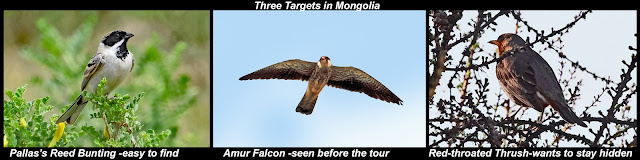
My next venture turned out to be one of my most enjoyable trips ever, and netted me Red-throated Thrush (I missed the only UK record by not going on the way home from Gatwick, next day-gone!), Amur Falcon and Pallas's Reed Bunting. The last could be split, and I don't know which subspecies UK records are assigned to, but lydiae is resident and we also saw the migratory birds. A recent trip to Finland got me Tengmalm's Owl, but unfortunately it was a poor year for Hawk Owl, so four to go still.

The great thing about personal targets is that it gives you a focus of where to go. I don't stick to it exclusively, I sidetracked to Thailand earlier this year to photograph Spoon-billed Sandpiper whilst we still can, conservation efforts have been greatly hampered by the fact its breeding grounds are in Russia. The first target I set myself, after that of seeing as many birds as I could in Britain (which is a lot of fun but ultimately very expensive and never-ending), was to see every species of gull in the world. I chose gulls for several reasons, but ultimately it was because there are only about six families which occur on every continent, and gulls would be the most interesting. Oddly, two I have only seen in the UK (Ross' and Ivory). Another, if you include Subantarctica as part of the Antarctic, is Pipits, but seeing every Pipit in the world would bore me to death. I saw all the gulls long ago, but I can always think of a new target if I run out of ideas. Waders has always been there, the Caspian Plover mentioned earlier was also my 200th wader, but I've never tried to see every wader, although I only need Javan Plover to complete "conventional" ones. So, if I see my last four UK birds, I'll be planning a trip to Indonesia, where I've never been, unless I come up with something else! I don't have a bucket list as it just keeps getting longer.

Most targets will have been achieved by someone else with more time and money, but it doesn't matter. If you crave competitiveness then pick something like a county year list, or the Western Palearctic, but otherwise go for something achievable to you. You can make it difficult (like all the world's Pittas) or easy, (like 250 in a year), but it always gives you something to look forward to, at least till you can no longer bird physically.


Comments
Post a Comment